Ipamorelin, Tesamorelin and CJC-1295: Two Receptors, Three Compounds, One Approval
Ipamorelin, Tesamorelin and CJC-1295 get grouped as growth hormone peptides. They split two ways on mechanism, and only one of the three has ever been approved.
The short version
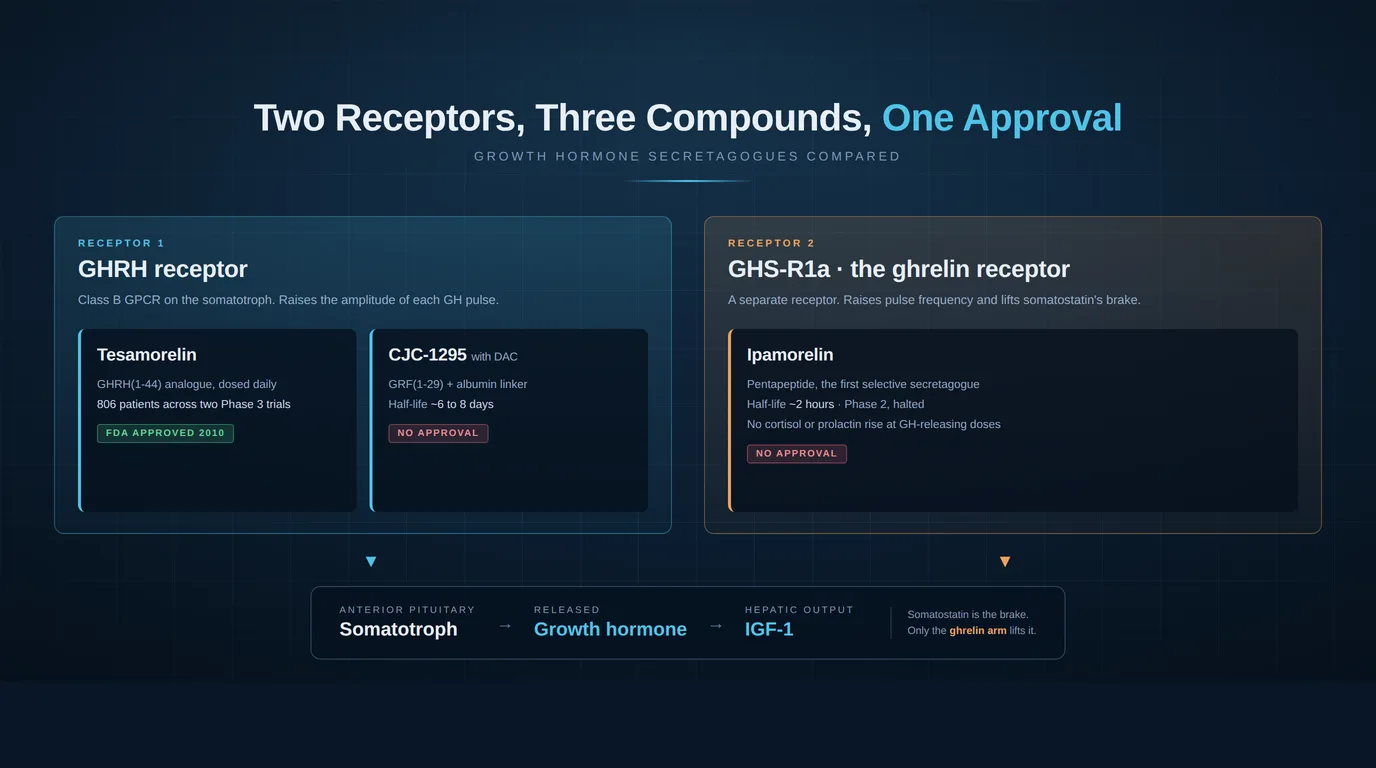
- Tesamorelin and CJC-1295 bind the GHRH receptor. Ipamorelin binds the ghrelin receptor, GHS-R1a. Two mechanisms, not one.
- Tesamorelin is the only one approved: FDA 2010, for HIV-associated lipodystrophy, on 806 patients across two Phase 3 trials.
- "CJC-1295 without DAC" is Modified GRF (1-29), a different molecule. Half-life is about thirty minutes against six to eight days.
- No controlled trial in healthy adults has measured body composition, recovery or sleep for any of the three.
- In July 2026 an FDA advisory committee recommended six peptides for 503A compounding. Neither Ipamorelin nor CJC-1295 was reviewed.
Evidence: Phase 3 and earlier. Ipamorelin and CJC-1295 hold no marketing authorisation from the MHRA, FDA, EMA or any other regulator, for any indication, anywhere. Tesamorelin is FDA-approved for one narrow population and is not available on prescription in the UK. Nothing here is medical advice, and nothing here should be read as a protocol.
These three turn up on the same lists, in the same articles, under the same heading. The grouping isn't wrong, exactly. All three raise growth hormone, all three are injected, all three are peptides. But it flattens two differences that decide almost everything worth knowing about them.
The first is mechanical. Tesamorelin and CJC-1295 bind one receptor. Ipamorelin binds a different one. They aren't variations on a theme, they're two separate ways into the same pituitary.
The second is evidential. One of the three cleared Phase 3 and got a licence. The other two didn't finish development.
And then there's the third thing, which is specific to CJC-1295: the name refers to two different molecules with half-lives that differ by a factor of about three hundred. Most of what gets sold under that name is the one that isn't CJC-1295.
Where the evidence stands, in short
Tesamorelin is a synthetic analogue of human growth hormone-releasing hormone. The FDA approved it in November 2010 as Egrifta, for reducing excess visceral abdominal fat in people with HIV-associated lipodystrophy. Two Phase 3 trials, 806 participants pooled, 26 weeks at 2 mg daily. Visceral fat fell 18% in one trial and 14% in the other, against 2% on placebo in both. Stop the drug and the fat comes back.
Ipamorelin is a pentapeptide that binds the ghrelin receptor. It was built at Novo Nordisk in the 1990s as the first genuinely selective growth hormone secretagogue, and the selectivity is the interesting part rather than the potency. Development reached Phase 2 for post-operative ileus and stopped there.
CJC-1295 with DAC is a GHRH analogue engineered to bind serum albumin, which stretches its half-life to roughly six to eight days. Human data exists (Teichman et al., 2006) showing IGF-1 elevated for the better part of a week off a single dose. Development was discontinued and the public record on why is thin.
CJC-1295 without DAC isn't CJC-1295. It's Modified GRF (1-29), a different compound with a half-life of about thirty minutes. More on this below, because it's the most commonly repeated error in the category.
The split that matters: two receptors, not one
Growth hormone release from the pituitary runs on two accelerators and one brake.
The accelerator most people know is GHRH, released from the hypothalamus, binding the GHRH receptor on somatotroph cells. That's the pathway Tesamorelin and CJC-1295 use. Both are GHRH analogues, both engineered versions of the same native hormone, both differing from it mainly in how long they survive in circulation.
The second accelerator is the ghrelin receptor, GHS-R1a. Ghrelin is the stomach hormone best known for hunger signalling, and it also drives growth hormone release through a separate mechanism. Ipamorelin is a synthetic agonist at this receptor. It has no activity at the GHRH receptor at all.
The brake is somatostatin, which suppresses growth hormone release. Ghrelin receptor agonists reduce somatostatin tone, which is part of why they work.
So the honest grouping is two GHRH analogues and one ghrelin mimetic, sharing an outcome and almost nothing else. When you see the three listed together as interchangeable options, that's the tell that the writer worked from a supplier catalogue rather than the pharmacology.
Tesamorelin: the one with an approval
Tesamorelin is GHRH(1-44) with a trans-3-hexenoyl group attached to the N-terminus. That modification exists for one reason: native GHRH is cleaved by the enzyme DPP-4 within minutes, and the added group blocks the cleavage site. The result survives long enough to be dosed once a day.
The approval is narrow and worth reading precisely. It covers reduction of excess visceral adipose tissue in HIV-infected patients with lipodystrophy. Not general fat loss, not body recomposition in healthy adults, not anti-ageing. The population studied had a specific metabolic problem caused by a specific drug class, and the trials measured a specific fat depot by CT scan.
| Phase 3 trial | Patients | Visceral fat change | Placebo |
|---|---|---|---|
| Trial 1, 26 weeks, 2 mg daily | 412 | 18% reduction | 2% reduction |
| Trial 2, 26 weeks, 2 mg daily | 404 | 14% reduction | 2% reduction |
| Pooled | 806 | Consistent across subgroups | |
Falutz et al. ran the pivotal work, published in the New England Journal of Medicine in 2007 and pooled in a later analysis. Subcutaneous fat was largely unaffected, which is the finding that made it interesting: the drug moved one fat depot and left the other alone. IGF-1 rose as expected. The effect reversed after discontinuation, so it behaves like a maintenance therapy rather than a course.
Later work looked at liver fat in the same population (Stanley et al., Lancet HIV) with reductions in hepatic fat fraction, and there's a smaller literature on cognition in mild cognitive impairment. Neither has produced a second approval.
Reported adverse effects track what you'd expect from raising growth hormone: arthralgia, peripheral oedema, myalgia, paraesthesia, injection site reactions, and impaired glucose tolerance. It's contraindicated in active malignancy, in pregnancy, and where the hypothalamic-pituitary axis is disrupted.
Tesamorelin is the only compound in this article with a regulator's name on it, and even then the licence describes a population that most people reading about it don't belong to.
Ipamorelin: selective, and that's the whole point
The growth hormone-releasing peptides that came before Ipamorelin worked, and they worked messily. GHRP-6, GHRP-2 and hexarelin all raise growth hormone, and at the doses that do it they also move cortisol, ACTH and prolactin. For a drug meant to be given repeatedly, that's a problem.
Raun et al. published Ipamorelin in 1998 as the first selective compound in the class. At doses producing a full growth hormone response, ACTH and cortisol stayed at baseline. That's the entire reason the molecule is notable, and it's why it still gets discussed almost thirty years later despite never reaching market.
There's a second oddity. Ipamorelin binds the ghrelin receptor, and ghrelin is the hunger hormone, yet Ipamorelin produces comparatively little appetite stimulation next to GHRP-6. The receptor is the same. The downstream behaviour isn't. Nobody has fully explained this, and it's a reasonable argument that receptor-level selectivity is more complicated than an agonist/antagonist binary.
Clinically it went to Phase 2 for post-operative ileus, where the reasoning was that ghrelin receptor agonism promotes gastric motility. It didn't progress. Half-life is roughly two hours.
What Ipamorelin does not have is a single controlled trial in healthy adults measuring body composition, recovery, sleep quality or any of the outcomes it's discussed for. The mechanism is well characterised. The clinical claims attached to it are not. That gap between a clean preclinical file and an empty clinical one is a pattern in this space, and we've written about a starker version of it in the BPC-157 preclinical file.
CJC-1295: two molecules, one name
This is the part that most coverage gets wrong, and the error is baked into how the compound is sold.
CJC-1295 is GRF(1-29), the biologically active fragment of GHRH, carrying four amino acid substitutions that resist enzymatic breakdown, plus a maleimidoproprionic acid linker on the C-terminus. That linker is the Drug Affinity Complex, the DAC. It forms a covalent bond with cysteine-34 on serum albumin, and albumin then carries the peptide around for days instead of minutes.
The DAC is the invention. Take it away and you have a different drug.
| CJC-1295 with DAC | "CJC-1295 without DAC" | |
|---|---|---|
| Actual name | CJC-1295 | Modified GRF (1-29) |
| Albumin linker | Yes | No |
| Half-life | ~6 to 8 days | ~30 minutes |
| Human data | Teichman et al., 2006 | Limited |
Teichman et al. published the human pharmacokinetics in 2006. Single subcutaneous doses produced growth hormone elevation and IGF-1 increases in the range of one and a half to three times baseline, sustained for six days or more. That's the property nothing else in the class has, and it's what ConjuChem was developing.
What's sold as "CJC-1295 without DAC" is Modified GRF (1-29): the same four substitutions, no albumin linker, half-life around thirty minutes. It's a real compound with a real rationale, and calling it CJC-1295 is like calling a car without an engine a car with the engine removed. The name refers to the thing that was taken out.
The practical consequence is that two products under one label produce completely different pharmacology. One elevates IGF-1 for most of a week. The other clears before you've finished the washing up. Any article, forum post or product page that discusses "CJC-1295" without saying which one is describing nothing in particular.
We covered the same failure mode from a different angle in TB-500 and Thymosin Beta-4, where a fragment and its parent molecule get treated as one compound. It's the most reliable way to spot writing that hasn't gone back to the primary literature.
Development of CJC-1295 with DAC stopped. Publicly available detail on the decision is limited, and we're not going to speculate past what's documented.
Side by side
| Tesamorelin | Ipamorelin | CJC-1295 (with DAC) | |
|---|---|---|---|
| Class | GHRH analogue | Ghrelin mimetic (GHRP) | GHRH analogue |
| Receptor | GHRH receptor | GHS-R1a | GHRH receptor |
| Structure | GHRH(1-44) + trans-3-hexenoyl | Pentapeptide | GRF(1-29), 4 substitutions + albumin linker |
| Half-life | Minutes in circulation, dosed daily | ~2 hours | ~6 to 8 days |
| Best human data | Two Phase 3 trials, 806 participants | Phase 2, post-operative ileus | Phase 1/2 pharmacokinetics |
| Approval status | FDA-approved 2010, HIV lipodystrophy only | None, anywhere | None, development discontinued |
| Cortisol and prolactin | Not a feature of the mechanism | Minimal, its defining property | Not a feature of the mechanism |
Why the two mechanisms get combined
The standard argument for pairing a GHRH analogue with a ghrelin receptor agonist is that they act on separate control points. The GHRH arm raises the amplitude of a growth hormone pulse. The ghrelin arm raises pulse frequency and lifts somatostatin's brake. Combined, the growth hormone response is larger than either produces alone, and this synergy is documented for GHRH and GHRP combinations in the endocrinology literature going back to the 1990s.
The mechanism is sound. What doesn't exist is controlled outcome data. No trial has taken healthy adults, given them a GHRH analogue plus a ghrelin mimetic, and measured lean mass, fat mass, injury recovery or sleep architecture against placebo over a meaningful period. The synergy is a pharmacological observation about hormone concentrations in blood, and hormone concentrations are not outcomes.
What raising growth hormone actually costs
Every compound here works by increasing growth hormone and, downstream, IGF-1. The predictable effects of sustained elevation are well documented from growth hormone therapy: fluid retention, joint pain, carpal tunnel symptoms, and reduced insulin sensitivity. Tesamorelin's label carries the glucose warning for this reason.
The longer-term question is IGF-1 itself, which is mitogenic. Epidemiological work has found associations between IGF-1 in the high-normal range and incidence of certain cancers. That's an association in observational data, not a demonstrated causal effect of these compounds, and it's the reason growth hormone therapies are contraindicated in active malignancy.
The usual counter-argument is that secretagogues act through the pituitary, so the body's own negative feedback stays partly intact and the ceiling on growth hormone is lower than with injected growth hormone. That's mechanistically reasonable. It has not been tested over years in healthy people, because those trials haven't been run.
What remains unknown
- Whether any of the three changes body composition in healthy adults. No trial has asked.
- Whether Tesamorelin's visceral fat effect generalises beyond HIV-associated lipodystrophy. The trials were run in one population for a reason.
- Why Ipamorelin separates growth hormone release from appetite when both run through the same receptor.
- What long-term IGF-1 elevation from a secretagogue does over five or ten years.
- Why CJC-1295 development stopped.
Regulatory position
All three are prohibited in sport at all times under WADA's S2 category, covering peptide hormones, growth factors and mimetics. GHRH analogues and growth hormone secretagogues are both named there. A negative growth hormone test doesn't clear you, because the assays target the secretagogues directly.
The US compounding position is where this gets misreported, so the dates matter.
| Date | What happened |
|---|---|
| September 2023 | FDA moved more than a dozen peptides into Category 2 of the interim 503A bulks list, CJC-1295 and ipamorelin acetate among them. |
| September 2024 | Both removed from Category 2 after the nominators withdrew their nominations. Procedure, not a safety finding. |
| July 2026 | The Pharmacy Compounding Advisory Committee recommended six peptides for the 503A list. Neither compound was on the agenda. |
Category 2 means the agency has identified significant safety risks, and in practice it means don't compound this. Vendor copy tends to present the 2024 removal as a safety clearance. It wasn't. Neither compound has ever been on Category 1, the list of substances that may actually be used. Coming off one list didn't put them on the other.
Then came July 2026. The committee met on the 23rd and 24th and reviewed seven peptides, recommending six of them for the 503A affirmative list: BPC-157, KPV, TB-500, MOTS-c, epitalon and semax, with emideltide voted down. Those votes were close, several at 8-6 or 7-5 with abstentions, and the committee only advises. The FDA decides.
Ipamorelin and CJC-1295 were not on that agenda. When the door opened a crack for six other compounds, neither of these was in the room. That's the current position: no approval as medicines, no place on the affirmative compounding list, and no pending review that would change either.
The UK position under the MHRA is separate again, and we've set out where things stand in Peptide Regulation in 2026.
Material sold online as research chemicals sits outside all of this. It carries no marketing authorisation, no pharmacopoeial standard and no guarantee of identity or purity beyond whatever the seller publishes. For a compound like CJC-1295, where two molecules share one name in common usage, label ambiguity isn't a hypothetical risk.
Frequently asked
Which of the three is strongest?
Wrong axis. CJC-1295 with DAC produces the longest IGF-1 elevation from a single dose, Tesamorelin has the only demonstrated clinical outcome, and Ipamorelin has the cleanest hormonal selectivity. They're not competing for the same job.
Is Tesamorelin available in the UK?
It isn't licensed for UK use. FDA approval covers the US, for HIV-associated lipodystrophy specifically.
Are Ipamorelin and CJC-1295 legal?
Neither is approved as a medicine anywhere. Legality of possession, sale and import varies by jurisdiction and is a separate question from whether either can be legitimately prescribed, which they can't.
What's the difference between CJC-1295 and Modified GRF (1-29)?
The albumin linker, and therefore the half-life: days versus about thirty minutes. Products labelled "CJC-1295 without DAC" are Modified GRF (1-29).
Does Ipamorelin cause hunger?
Less than other ghrelin receptor agonists, which is unusual given the receptor it binds. GHRP-6 by comparison produces marked appetite stimulation.
Can these raise growth hormone without the side effects of growth hormone therapy?
The theory is that pituitary feedback limits the peak. The trials needed to test that in healthy people over years haven't been run.
Do any of them build muscle?
No controlled trial in healthy adults has measured it for any of the three.
Didn't the FDA just approve peptides for compounding?
In July 2026 an advisory committee recommended six peptides for the 503A list, including BPC-157 and TB-500. Ipamorelin and CJC-1295 weren't reviewed. A committee recommendation also isn't an FDA decision.
Why is Tesamorelin approved when the others aren't?
It completed Phase 3 in a defined population with a measurable endpoint on CT imaging. The other two stopped before that point.
References
- Raun K, et al. Ipamorelin, the first selective growth hormone secretagogue. European Journal of Endocrinology, 1998.
- Teichman SL, et al. Prolonged stimulation of growth hormone and insulin-like growth factor I secretion by CJC-1295, a long-acting analog of GHRH, in healthy adults. Journal of Clinical Endocrinology & Metabolism, 2006.
- Falutz J, et al. Metabolic effects of a growth hormone-releasing factor in patients with HIV. New England Journal of Medicine, 2007.
- Stanley TL, et al. Effects of tesamorelin on non-alcoholic fatty liver disease in HIV. The Lancet HIV, 2019.
- EGRIFTA prescribing information, US Food and Drug Administration.
- WADA Prohibited List, section S2: Peptide Hormones, Growth Factors, Related Substances and Mimetics.
- FDA, Interim 503A Bulk Drug Substances Categories, updated 29 September 2023 and 20 September 2024.
- FDA Pharmacy Compounding Advisory Committee, meeting of 23 to 24 July 2026, voting results.