Collagen Peptides: The One With Actual Human Trials
Unusually for this space, the core findings come from controlled trials in people. Effect sizes are modest, and the protocol matters more than the product.
Marcus Lin
Research Editor · August 25, 2026
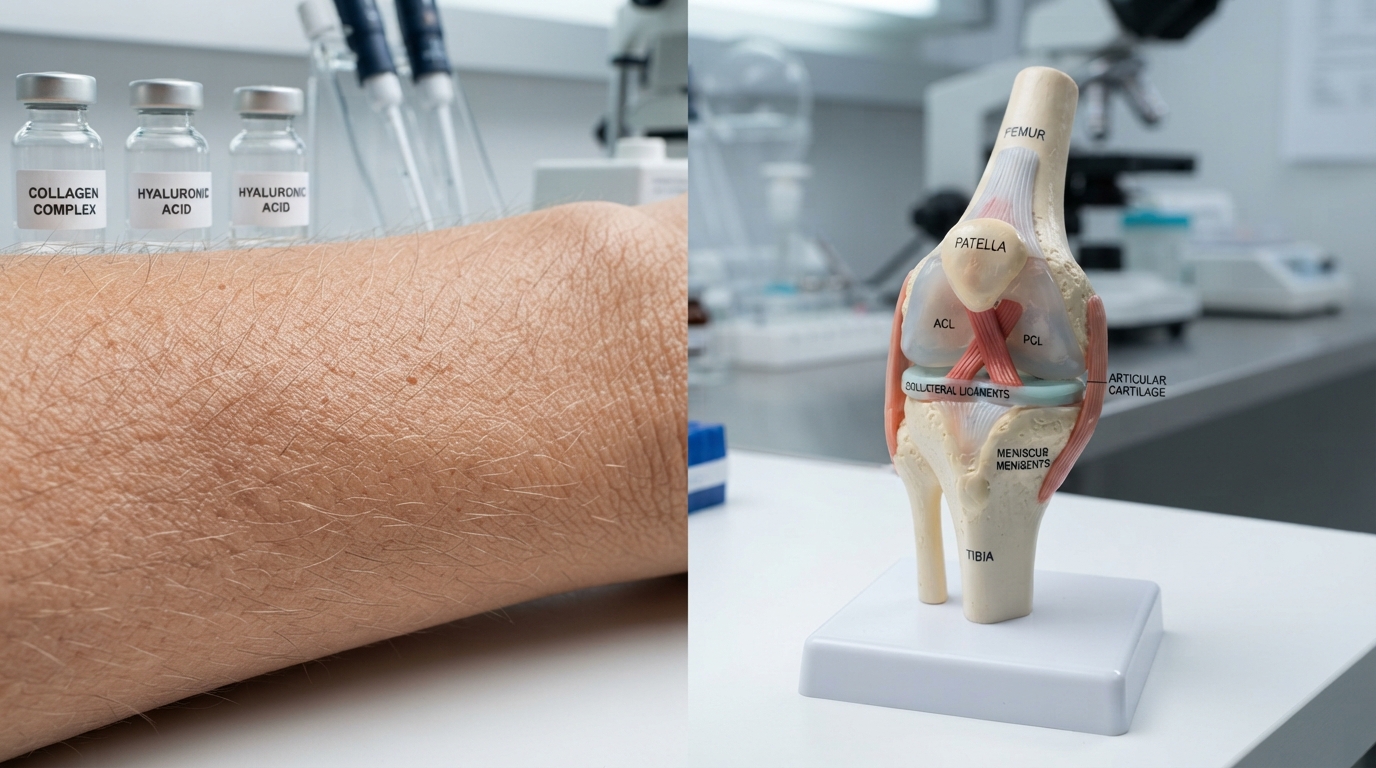
Evidence tier: Human RCT. Unusually for this space, the core findings come from controlled trials in people rather than rodent models. Effect sizes are modest, the protocol matters more than the product, and the marketing still overreaches.
Collagen is an odd entry in the peptide conversation. It was dismissed for decades as a poor protein source, which was correct on the metric being applied and wrong about what the molecule actually does. It then acquired a reputation as a beauty supplement, which flattened a genuinely interesting mechanism into a skincare claim.
The reality sits between those. Collagen peptides have real, replicated human evidence for connective tissue adaptation. The effects are smaller than the marketing implies and more dependent on protocol than almost anything else in this category.
Why the old dismissal was wrong
Collagen makes up roughly 30% of total protein mass in the body. Type I dominates tendon, ligament, bone and skin; type II dominates cartilage. Each molecule is a triple helix rich in glycine, proline and hydroxyproline — the last being essentially unique to collagen, which is why it's used as a research marker for collagen turnover.
Dietary collagen was written off because it's low in leucine and other essential amino acids relevant to muscle protein synthesis. That assessment was accurate and beside the point. The interesting biology isn't the amino acid pool it contributes. It's the short peptide fragments that survive digestion intact and act as signals.
The bioactive fragment mechanism
Hydrolysed collagen is enzymatically pre-digested, with an average molecular weight around 3–5 kDa. When ingested, a meaningful fraction is absorbed as intact di- and tripeptides — particularly prolyl-hydroxyproline (Pro-Hyp) and hydroxyprolyl-glycine (Hyp-Gly). These appear in circulation within an hour and stay elevated for several hours (Iwai et al., 2005).
That's the finding the whole field rests on, and it's worth appreciating why it was surprising. Peptides generally don't survive digestion. These do, and once circulating they act on fibroblasts in skin and connective tissue, upregulating type I collagen synthesis, hyaluronic acid production and matrix remodelling.
So collagen peptides function as both substrate and signal. That dual role is unusual and explains why the effects aren't simply proportional to protein intake.
The protocol that carries the evidence
Shaw and colleagues showed that 15 g of gelatin with vitamin C, taken roughly an hour before an intermittent loading stimulus, doubled serum markers of collagen synthesis against placebo (Shaw et al., 2017).
The timing logic is the whole finding:
- Collagen peptides peak in circulation 30–60 minutes after ingestion
- Loaded connective tissue temporarily increases its capacity for collagen synthesis in a window after the load
- Overlapping peak circulating peptides with peak local synthesis capacity produces the additive effect
Miss the overlap and you have peptides circulating when the tissue isn't primed to use them.
| Element | Detail |
|---|---|
| Dose | ~15 g hydrolysed collagen peptides |
| Cofactor | 50 mg vitamin C, taken with it |
| Timing | ~60 minutes before loading |
| Stimulus | 5–10 minutes of targeted loading of the tissue in question |
| Frequency | Twice daily has better support for tendon adaptation than once |
The vitamin C isn't incidental or a marketing addition. It's a required cofactor for prolyl and lysyl hydroxylase, the enzymes that hydroxylate proline and lysine residues in nascent collagen. Without adequate vitamin C you have collagen precursors rather than functional collagen. This is the same biochemistry that makes scurvy a connective tissue disease.
What the human evidence supports
Tendon and ligament adaptation. The Shaw protocol has been replicated and extended into tendinopathy, jumper's knee and general tendon-adaptation contexts. This is the strongest arm of the file.
Cartilage and joint pain. Meta-analyses in knee osteoarthritis show small-to-moderate improvements in pain and function. Not dramatic, but consistent enough to belong in a legitimate joint-support conversation, particularly in early-stage osteoarthritic change.
Skin. Multiple RCTs show measurable improvements in elasticity, hydration and wrinkle depth over 8–12 weeks of daily use, predominantly in middle-aged and older women. Effect sizes are modest but reproducible — which is more than most cosmetic-adjacent supplements can claim.
Post-injury rehabilitation. Collagen peptides paired with progressive loading have accumulated a reasonable base of small clinical trials in tendinopathy and ACL reconstruction, and are increasingly appearing in mainstream sports medicine protocols.
| Domain | Evidence | Confidence |
|---|---|---|
| Pro-Hyp / Hyp-Gly absorption | Well characterised | High |
| Tendon synthesis with 15 g + vit C + loading | Robust experimental support | High |
| Skin elasticity and hydration | Multiple RCTs | Moderate–high |
| Osteoarthritis pain and function | Meta-analytic, modest effect | Moderate |
| Post-injury rehabilitation | Growing trial base | Moderate |
| Bone density | Emerging positive signals | Low–moderate |
| Hypertrophy support | Poor — not a complete protein | High confidence against |
Where the marketing overreaches
"Collagen builds muscle." It doesn't. It's not leucine-rich and doesn't meaningfully drive muscle protein synthesis on its own. Whey and whole-food protein remain the appropriate substrates for hypertrophy. That matters in the context of rapid pharmacological weight loss, where preserving lean mass is a real concern — see our piece on GLP-1 agonists and the muscle loss question. Collagen supplements a normal protein intake; it doesn't substitute for any of it.
"Marine collagen is dramatically better than bovine." Both work. Type I collagen is type I collagen. Marine sources have somewhat different peptide fingerprints but comparable clinical effect at matched doses. Choose on cost and tolerance.
"Type II for joints, type I for skin." Biochemically real, substantially overstated at the supplement level. Most trial evidence uses generic hydrolysed collagen without that differentiation.
"Collagen reverses ageing." It modestly supports skin elasticity and hydration. It does not reverse the architectural changes in aged skin, and no supplement does.
"Any collagen, any time." This is the one that costs people results. A scoop stirred into morning coffee has considerably thinner evidence than 15 g with vitamin C an hour before loading. The protocol is doing most of the work in the trials.
Against the repair-signalling peptides
Collagen and compounds like BPC-157 or TB-500 are frequently discussed in the same breath. They're complementary rather than comparable.
| Mechanism | Evidence base | |
|---|---|---|
| Collagen peptides | Substrate plus Pro-Hyp signalling to fibroblasts | Solid human RCT data |
| BPC-157 | Nitric oxide, VEGFR2, growth factor upregulation | Strong preclinical, essentially no human |
| TB-500 | Actin regulation, angiogenesis, macrophage polarisation | Strong preclinical, essentially no human |
The evidence asymmetry is the point. Collagen is the only one of the three with controlled human trials behind it, and it's also the cheapest, safest and most available. That ordering is worth sitting with before reaching past it for something with a more interesting mechanism and no human data.
Editorial perspective
Collagen moved from folk remedy to mechanistically coherent human evidence without much marketing noise doing the work, which is unusual and worth respecting.
The effect sizes are real and modest. Anyone expecting transformation of aged skin or an advanced osteoarthritic joint will be disappointed. Anyone looking to nudge tendon adaptation over months alongside progressive loading has a legitimate tool with actual trial support.
The protocol is the intervention. Fifteen grams with vitamin C timed to a loading stimulus is what was tested. Deviating from that isn't necessarily useless, but it isn't what the evidence describes.
It sits alongside loading, not instead of it. Mechanical load is what drives connective tissue remodelling. Collagen improves the substrate and signal available to a process that load initiates. No quantity of it substitutes for the progressive loading the tissue requires.
Open questions
- Long-term outcomes in age-related tendinopathy and osteoarthritis
- Head-to-head comparison of Pro-Hyp-enriched versus generic hydrolysates
- Interaction with resistance training for bone density outcomes
- Standardised protocols in ACL and Achilles rehabilitation
- Sex-based differences in dose response and skin outcomes
Frequently asked
How much should I take?
The best-supported protocol is 15 g of hydrolysed collagen with 50 mg vitamin C, roughly an hour before loading. For skin and joint outcomes, daily consistency matters more than exact timing.
Bovine or marine?
Both effective at matched doses. Choose on cost, tolerance and dietary preference.
Does it count toward daily protein?
Technically, but it shouldn't displace complete protein sources. Low in leucine and essential amino acids. Treat it as an addition, not a substitution.
Do I need the vitamin C?
Functionally yes — it's a required enzymatic cofactor. If your dietary intake is already adequate, additional dosing alongside the collagen is optional rather than essential.
How long before effects appear?
Skin: 8–12 weeks of consistent use. Joints: 3–6 months. Tendon: synthesis markers move within days, but structural change takes months of loading.
Is it safe?
Extremely well tolerated at standard doses. Rare allergic reactions to specific source proteins occur.
Does it help hair and nails?
Some evidence for nail growth rate and quality. Hair effects are less established.
Why does it have so much better evidence than other peptides?
It's a food ingredient rather than a drug, so it can be studied without the regulatory and commercial barriers that keep compounds like BPC-157 out of trials. The bar to running a collagen RCT is low. That's the whole explanation.
References
- Iwai K, et al. Identification of food-derived collagen peptides in human blood after oral ingestion of gelatin hydrolysates. J Agric Food Chem. 2005.
- Shaw G, et al. Vitamin C-enriched gelatin supplementation before intermittent activity augments collagen synthesis. Am J Clin Nutr. 2017.
- Bello AE, Oesser S. Collagen hydrolysate for the treatment of osteoarthritis and other joint disorders. Curr Med Res Opin. 2006.
- Choi FD, et al. Oral collagen supplementation: a systematic review of dermatological applications. J Drugs Dermatol. 2019.
- Clifford T, et al. The effects of collagen peptides on muscle damage, inflammation and bone turnover following exercise. Amino Acids. 2019.
- Zdzieblik D, et al. Improvement of activity-related knee joint discomfort following supplementation of specific collagen peptides. Appl Physiol Nutr Metab. 2017.