TB-500 and Thymosin Beta-4: Why the Fragment Isn't the Molecule
Most writing about TB-500 cites research about Thymosin Beta-4. Those are not the same thing, and the gap between them is the most important fact about this compound.
Dr. Elena Marsh
Biochemist · August 25, 2026
Evidence tier: Preclinical. Controlled human data on the TB-500 fragment specifically is essentially absent. The clinical work that exists is on the full-length parent molecule, in ophthalmology, with mixed results.
Most writing about TB-500 cites research about Thymosin Beta-4. Those are not the same thing, and the gap between them is the most important fact about this compound.
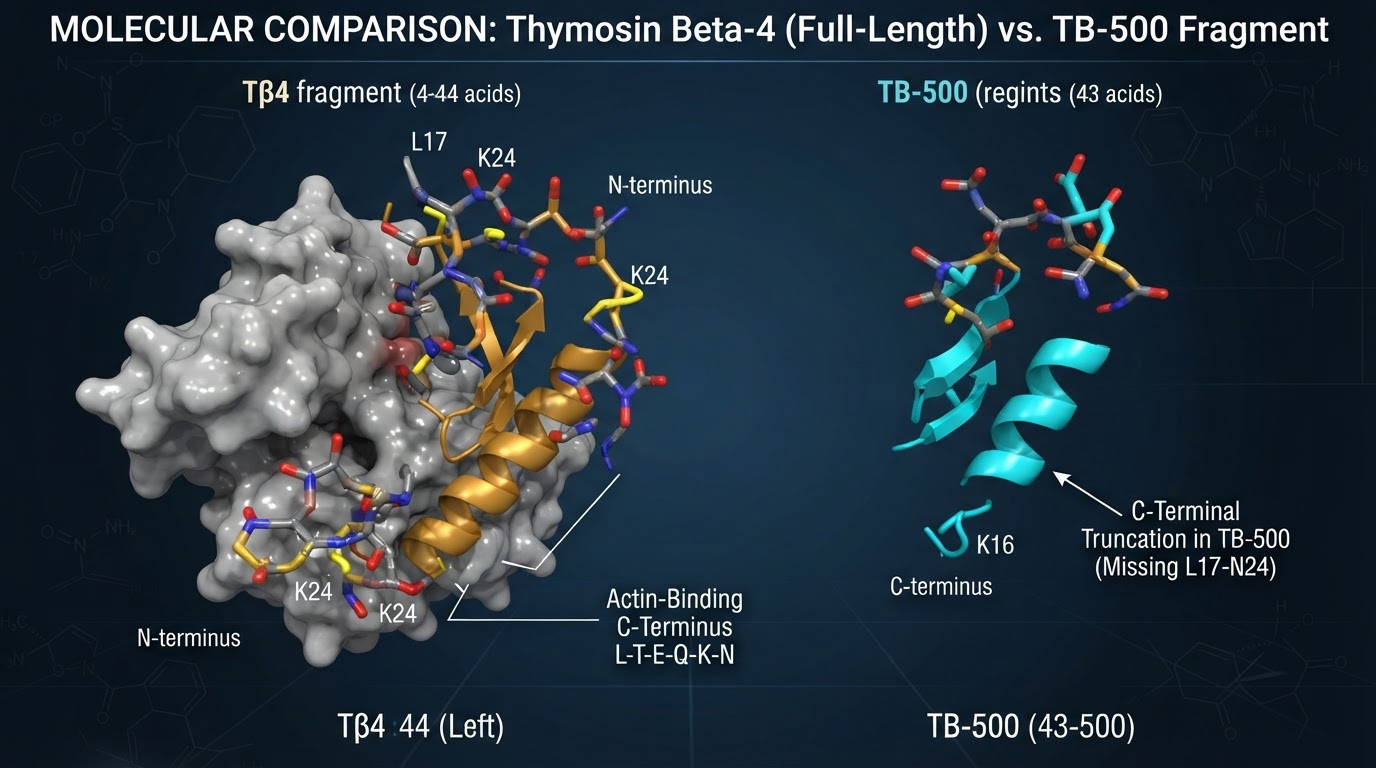
Thymosin Beta-4 (Tβ4) is a 43-amino-acid peptide the body produces in bulk. TB-500 is a synthetic fragment built around one active region of it. The fragment carries some of the parent molecule's signalling. Whether it carries all of it has never been properly established, and the marketing language routinely collapses the distinction that the literature maintains.
This article covers the parent molecule first, because that's the only honest way to discuss the fragment.
A repair molecule the body already makes in quantity
Tβ4 isn't obscure biology. It sits at hundreds of micromolar concentrations inside platelets, macrophages and endothelial cells — by some estimates around 0.5% of total soluble protein in certain cell types. It's released into circulation whenever those cells degranulate at a site of injury.
That abundance is the point. The body didn't evolve Tβ4 as an occasional patch. It's a baseline component of every repair event, present before the injury and released the moment one occurs.
What it does inside the cell
Tβ4 is the primary G-actin-sequestering peptide in vertebrate cells. It binds monomeric actin and holds it in a reserve pool the cell can release on demand for filament assembly.
That sounds abstract until you consider what actin filaments do. Cell migration runs on them. When tissue is damaged, keratinocytes crawl across the wound bed, endothelial cells extend into the hypoxic zone, and macrophages traffic in to clear debris. None of that happens without a controlled supply of polymerisable actin. Tβ4 is the reservoir that supply draws from, and the local pool collapses as actin is unbound and polymerised into the leading edge of migrating cells.
What it does outside the cell
The intracellular story was the first chapter. The more interesting work over the past two decades concerns what Tβ4 does after leaving the cell.
Released Tβ4 upregulates VEGF expression, supports endothelial cell migration, and shifts macrophages toward a reparative phenotype rather than a prolonged inflammatory one.
| Compartment | Function | Effect |
|---|---|---|
| Intracellular | G-actin sequestration | Buffers the monomer pool for on-demand filament assembly |
| Extracellular | Receptor binding, ECM interaction | Endothelial migration, angiogenesis, M2-leaning macrophage polarisation |
| Circulating | Released from platelet α-granules | Contributes to systemic repair signalling at the wound site |
The pattern echoes BPC-157: both molecules look less like direct growth factors and more like orchestrators of the repair environment, improving the conditions under which the body's own machinery operates.
Where TB-500 actually fits
TB-500 is a synthetic peptide built around the actin-binding domain of Tβ4 — commonly described as the region containing the LKKTETQ motif. It's a short stretch carrying a meaningful portion of the parent's known bioactivity.
| Full-length Tβ4 | TB-500 | |
|---|---|---|
| Length | 43 amino acids | Short fragment, LKKTETQ-region derived |
| Actin sequestration | Full activity | Retains the binding motif |
| Angiogenic / VEGF signalling | Well documented | Partial, less characterised |
| Clinical development | RGN-259 reached late-stage ophthalmic trials | No approved programme |
| Availability | Research reagent and investigational drug | Research-use only |
The practical implication: TB-500 carries the actin-related signalling but does not necessarily reproduce every effect of the parent. The fragment-specific literature is considerably thinner than the parent-molecule literature and concentrates on cardiac, dermal and corneal models in animals.
This is the inferential leap to watch for. When a discussion cites "Tβ4 studies" to justify TB-500, it's borrowing evidence from a longer, better-studied molecule. Sometimes that's reasonable. It's never automatic.
A note on certificates of analysis
Worth knowing if you read COAs: many certificates for material sold as TB-500 report a molecular weight corresponding to full-length Thymosin Beta-4 rather than the fragment on the label. This is common enough to be near-standard in the market. It doesn't necessarily indicate fraud — labelling conventions in this space are loose — but it does mean the document may not be confirming what the label claims. The same regulatory and labelling ambiguity runs through the wider research-peptide market.
What the preclinical work shows
Several findings recur across rodent and large-animal models.
Dermal repair. Accelerated re-epithelialisation in cutaneous wound models, with the largest effects in compromised settings — diabetic or aged skin, where baseline healing is impaired.
Angiogenesis. Improved vascular density in ischaemic tissue, attributed to endothelial migration support and VEGF upregulation (Malinda et al., 1997).
Cardiac repair. Reduced fibrotic scarring and improved functional recovery in murine and porcine infarct models, with reported reactivation of epicardium-derived progenitor cells (Bock-Marquette et al., 2004). This is the most striking work in the file — and it used full-length Tβ4, not the fragment.
Corneal repair. Faster healing of alkali-burn and surgical wounds, which became the basis for the ophthalmic clinical programme.
Neurological repair. Signals of enhanced remyelination and functional recovery in rodent stroke and traumatic brain injury models (Morris et al., 2010).
| Model | Signal | Note |
|---|---|---|
| Rodent dermal wound | Consistent | Largest effect in impaired-healing models |
| Rodent / porcine cardiac infarct | Consistent, mechanistically coherent | Predominantly full-length Tβ4 |
| Corneal wound | Strong | Basis for the RGN-259 programme |
| CNS injury (rodent) | Emerging | Remyelination and functional recovery |
| Human musculoskeletal outcomes | Absent | Anecdotal reports only |
The clinical reality check
The closest thing to clinical validation is RGN-259 — full-length Tβ4 as an ophthalmic drop, developed for dry eye and neurotrophic keratitis. It reached late-stage trials.
Results have been mixed rather than transformative.
That's useful calibration, and it cuts against the compound's reputation rather than for it. In the indication best positioned to succeed — direct topical application to an accessible tissue with a well-defined endpoint, using the full molecule rather than a fragment — the effect size has been modest. That should temper expectations about what a fragment does when injected systemically for a vaguer indication.
The half-life problem
Native Tβ4 has a short circulating half-life, on the order of an hour or two, and the fragment shares that limitation.
This is why research protocols use repeated administration rather than single doses, and why much of the discussion centres on local versus systemic delivery. It's also why claims about single-administration outcomes deserve heavy scepticism — the pharmacokinetics simply don't support that kind of effect.
TB-500 versus BPC-157
The two appear in the same conversations constantly. They are not interchangeable.
| TB-500 | BPC-157 | |
|---|---|---|
| Origin | Fragment of endogenous Tβ4 | Synthetic sequence from a gastric protein motif |
| Primary mechanism | Actin regulation, angiogenesis, macrophage polarisation | Nitric oxide modulation, VEGFR2, growth factor upregulation |
| Best-documented models | Cardiac, dermal, corneal | Tendon, ligament, GI, CNS |
| Gastric stability | No | Yes |
| Clinical development | Ophthalmic full-length programme | One small Phase 2 in IBD |
In research discussion they're often framed as complementary — TB-500 as the cell-migration and vascular signal, BPC-157 as the growth-factor and vascular-network arm. There is no published human trial of the combination, and no controlled preclinical work comparing the pair against either alone.
What this molecule is not
TB-500 and Tβ4 are not anabolic agents. They do not directly stimulate hypertrophy. They do not act like androgens or growth-promoting peptides. That places them in a different category from the metabolic and weight-loss pharmacology that dominates much of the current conversation.
The distinction matters because marketing in this space routinely collapses every compound into "performance enhancement," which is inaccurate. A molecule that improves wound-bed vascularisation is doing something categorically different from one that increases muscle protein synthesis. Conflating the two isn't a small imprecision — it changes what the compound is being claimed to do.
Worth noting for anyone competing: TB-500 is on the WADA prohibited list under peptide hormones and growth factors. It is banned in and out of competition.
Where the evidence stands
| Domain | Preclinical | Human | Confidence |
|---|---|---|---|
| Actin regulation, cell migration | Extensive | Mechanistic only | High |
| Angiogenesis / VEGF | Strong | Limited, ophthalmic | Moderate–high |
| Dermal wound repair | Strong | Emerging, topical Tβ4 | Moderate |
| Cardiac repair | Strong, multiple species | None controlled | Low–moderate |
| Musculoskeletal / tendon | Sparse fragment-specific data | None controlled | Low |
| Long-term human safety | Very limited | Very limited | Low |
The pattern is worth reading carefully. The domains with the strongest data — cardiac, corneal, dermal — are the ones nobody discusses. The domain everyone discusses, musculoskeletal recovery, has the thinnest fragment-specific evidence of any of them.
The safety question nobody has answered
Short-duration animal work reports a favourable profile. The unresolved issue is the same one that shadows BPC-157: sustained pro-angiogenic signalling.
Promoting new blood vessel growth is beneficial in a wound bed and is not obviously beneficial elsewhere. Whether long-term exposure carries measurable oncologic risk is a legitimate open question that has not been resolved in either direction. No study has shown harm; no adequately powered study has looked.
Immunogenicity with repeated dosing is also uncharacterised.
Editorial perspective
The mechanism is real, the preclinical signal is coherent, and the human evidence is thinner than the online conversation implies. Three things worth holding.
Most of the strongest data is on the parent, not the fragment. The cardiac remodelling work driving much of the clinical interest used full-length Tβ4. Reasoning from it to TB-500 is an inference, not a citation.
The one clinical programme produced modest results. RGN-259 is the best-case scenario for this molecule class and it didn't transform anything.
The claimed use cases have the least supporting data. Tendon healing, sprain recovery, chronic musculoskeletal complaints — these are precisely the settings with no fragment-specific controlled evidence. It's possible the molecule contributes something. It's equally possible that better sleep, better loading progression and adequate protein would produce the same subjective improvement. Both remain open.
What to watch
The interesting frontier for Tβ4-derived molecules probably isn't musculoskeletal. Ophthalmology, post-infarct cardiac remodelling and remyelination have produced the more rigorous data, and they're also where regulatory pathways are clearest.
Open questions that would move the picture:
- Whether the cardiac signal translates to measurable outcomes in human post-infarct cohorts
- Whether targeted delivery — local injection, sustained release, drops — changes the risk/benefit profile against systemic dosing
- Whether TB-500 specifically reproduces the angiogenic and anti-fibrotic effects of the full molecule, or whether fragment-versus-parent differences diverge meaningfully in vivo
- Whether the rodent remyelination signal generalises to human demyelinating disease
- Whether long-term exposure carries oncologic risk
For anyone following this, track the parent molecule's clinical development rather than the fragment's grey-market discussion. Real signal appears in peer review long before it appears in marketing.
Frequently asked
Is TB-500 the same as Thymosin Beta-4?
No. TB-500 is a synthetic peptide built around the actin-binding region. It carries part of the parent's activity and is not equivalent to the full 43-amino-acid molecule.
Is it approved anywhere?
No. It's research-use only with no approved therapeutic in the US, EU or UK. In the FDA's 2023 review it was placed in category 2, closing the compounding route. The nearest clinical programme is full-length Tβ4 in ophthalmology.
Does it build muscle?
No. It's not an anabolic agent. The documented activity concerns cell migration, angiogenesis and inflammation modulation — not muscle protein synthesis.
How does it compare to BPC-157?
Different molecules, different pathways, frequently discussed together and not interchangeable.
Are there safety concerns?
Long-term human data is essentially absent. The most legitimate open question is theoretical oncologic risk from sustained pro-angiogenic signalling, unresolved in either direction.
Is there any human data at all?
Mainly for full-length Tβ4 in ophthalmic indications, with mixed results. Controlled human data on the fragment specifically is essentially absent.
Why do COAs often show the wrong molecular weight?
Many report the mass of full-length Tβ4 rather than the fragment. It's near-standard in the market and reflects loose labelling convention more than deliberate misrepresentation — but it means the certificate may not confirm what the label claims.
References
- Malinda KM, et al. Thymosin β4 stimulates directional migration of human umbilical vein endothelial cells. FASEB J. 1997.
- Bock-Marquette I, et al. Thymosin β4 activates integrin-linked kinase and promotes cardiac cell migration, survival and cardiac repair. Nature. 2004.
- Goldstein AL, Hannappel E, Kleinman HK. Thymosin β4: actin-sequestering protein moonlights to repair injured tissues. Trends Mol Med. 2005.
- Sosne G, et al. Thymosin beta 4 and the eye. Ann N Y Acad Sci. 2010.
- Morris DC, et al. Thymosin β4 improves functional neurological outcome in a rat model of embolic stroke. Neuroscience. 2010.
- Crockford D, et al. Thymosin β4: structure, function, and biological properties. Ann N Y Acad Sci. 2010.