GLP-1 Agonists and the Metabolic Flexibility Question
The open question isn't whether these drugs work—it's what they leave behind. Do they improve underlying flexibility or just reduce the load on a broken system?
Dr. Priya Nair
Pharmacologist · August 25, 2026
Evidence tier: Phase 3 and beyond. Efficacy for weight and glycaemia is settled across dozens of RCTs with cardiovascular outcome data. The open question isn't whether these drugs work. It's what they leave behind.
There's no serious debate about whether GLP-1 agonists produce weight loss. The trial data is unambiguous and the effect sizes are among the largest in modern pharmacology.
The harder question is narrower and rarely asked cleanly: do these drugs improve underlying metabolic flexibility, or do they reduce the load on a system that remains as inflexible as it was? That distinction predicts what happens when the drug stops, which turns out to be the thing most people actually want to know.
What the drugs do
GLP-1 is an endogenous incretin released from intestinal L-cells in response to nutrients. It has four main actions: enhancing glucose-dependent insulin secretion, suppressing glucagon, slowing gastric emptying, and acting centrally to reduce appetite.
Pharmaceutical agonists are engineered for dramatically extended half-life — minutes for native GLP-1, days for semaglutide and tirzepatide.
| Agent | Targets | Status | Notes |
|---|---|---|---|
| Liraglutide | GLP-1 | Approved | Daily injection |
| Semaglutide | GLP-1 | Approved | Weekly; oral form available |
| Tirzepatide | GLP-1 + GIP | Approved | Weekly; largest effects among approved agents |
| Retatrutide | GLP-1 + GIP + glucagon | Investigational, Phase 3 complete | Filing expected 2027 |
What's settled
Weight loss. Semaglutide 2.4 mg produced approximately 15% mean loss over 68 weeks in STEP-1. Tirzepatide 15 mg produced approximately 21% over 72 weeks in SURMOUNT-1. Retatrutide, still investigational, produced 28.3% at 80 weeks in TRIUMPH-1 — covered in detail in our retatrutide Phase 3 readout.
Glycaemic control. HbA1c reductions of 1.5–2.0 percentage points in type 2 diabetes populations.
Cardiovascular outcomes. SELECT demonstrated MACE reduction with semaglutide in non-diabetic patients with obesity and established cardiovascular disease. This is the finding that moved these drugs from metabolic management into cardiovascular medicine.
Emerging indications. Signals across sleep apnoea, MASH and chronic kidney disease programmes.
Metabolic flexibility, defined
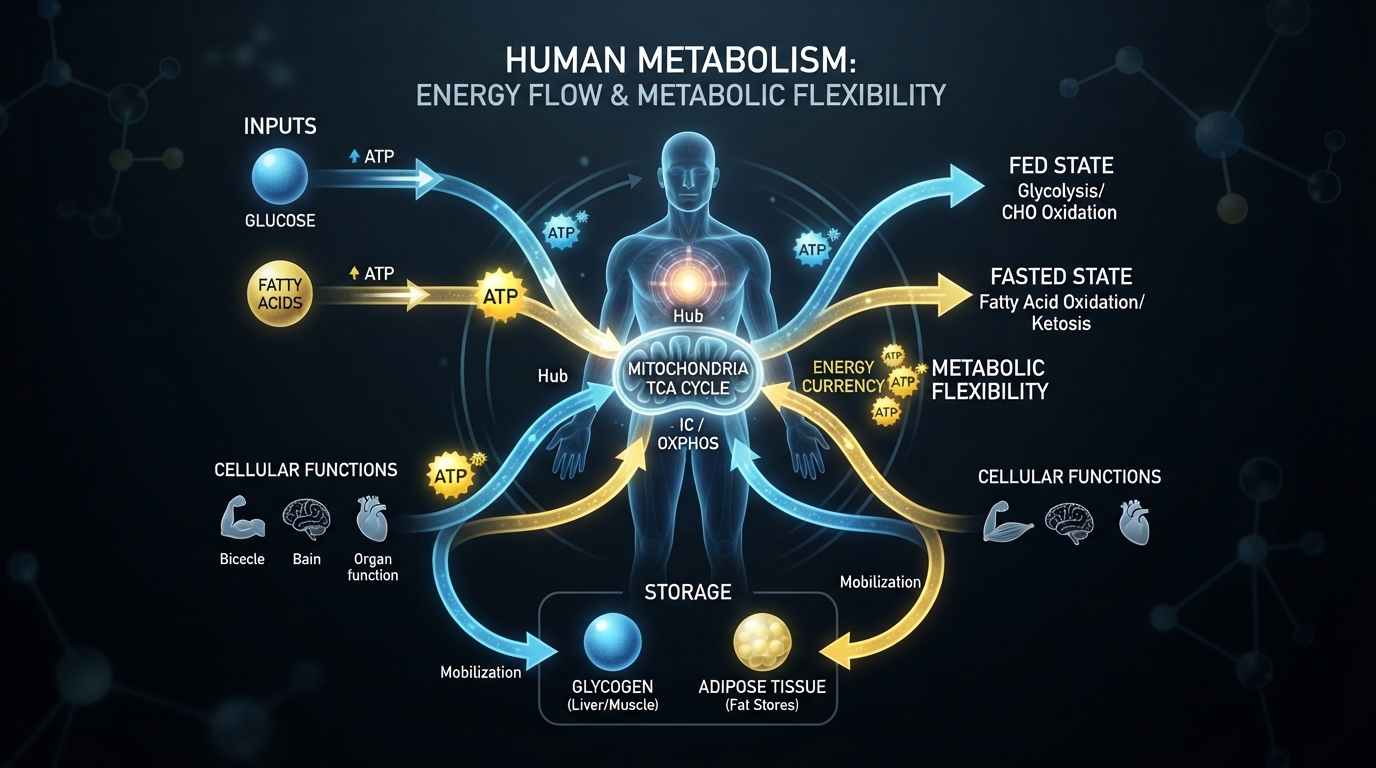
Metabolic flexibility is the capacity to switch cleanly between fuel sources — oxidising fat when fasted or at low intensity, oxidising glucose when fed or working hard.
Flexible looks like: low fasting insulin, efficient post-meal glucose clearance, rising fat oxidation with fasting duration, preserved mitochondrial capacity.
Inflexible looks like the inverse: persistently elevated insulin, incomplete glucose clearance, blunted fat oxidation, reduced mitochondrial function. This is the pathology upstream of type 2 diabetes, fatty liver disease and most of the metabolic syndrome cluster.
The question is where GLP-1 therapy acts on that picture.
The honest read
Insulin sensitivity improves substantially on therapy — but most of the improvement tracks with weight loss and reduced hepatic and pancreatic fat, not with a direct pharmacological effect on tissue insulin signalling.
Fasting insulin and HOMA-IR fall, sometimes dramatically.
Post-meal fat oxidation patterns in metabolic chamber studies don't show clean improvement in fuel-switching independent of body composition change.
Mitochondrial function isn't consistently improved beyond what the weight loss and any accompanying activity would produce anyway.
The mechanistic frame that fits: these drugs reduce the metabolic load, allowing an underlying system to compensate more easily. Whether that system becomes more resilient is largely determined by what happens alongside the pharmacology — resistance training, aerobic base, sleep, diet quality.
The drug opens a window. What goes into the window determines whether it matters after it closes.
The discontinuation problem
STEP-4 and multiple follow-up studies show that stopping therapy after significant loss typically results in regaining most of it — often two-thirds or more — within twelve months.
The mechanism is unmysterious. Appetite suppression ends. The physiological drive to defend the previous fat mass returns. Behavioural inputs that weren't rebuilt during pharmacotherapy remain exactly as they were.
This isn't a criticism of the drugs. It's a description of what obesity pharmacology is. These are chronic disease management, closer analogically to antihypertensives than to a course of antibiotics. Nobody expects blood pressure to stay down after stopping a beta blocker.
Framing GLP-1 therapy as a time-limited intervention is a setup for the regain that follows, and a great deal of consumer marketing frames it exactly that way.
The muscle loss question
Rapid weight loss under any mechanism carries disproportionate lean mass loss. Trial data suggests 25–40% of weight lost on semaglutide or tirzepatide is lean tissue — roughly comparable to fast diet-based loss, but a real concern for long-term functional capacity, particularly in older adults.
This isn't a side effect in the pharmacological sense. It's weight loss physics. Losing mass quickly costs muscle unless something actively defends it.
The levers with reasonable evidence:
- Protein intake at 1.6–2.2 g per kg of actual body weight, not target weight — collagen peptides can supplement this but should not displace complete protein
- Resistance training at least twice weekly throughout the loss phase
- Slower titration where clinically appropriate
None of these eliminate lean mass loss. They reduce the fraction.
Tolerability
| Category | Frequency | Note |
|---|---|---|
| Nausea | Very common | Usually attenuates over weeks |
| Diarrhoea / constipation | Common | Generally manageable |
| Delayed gastric emptying | Moderate | Relevant to anaesthesia — disclose before surgery |
| Gallbladder disease | Increased incidence | Related to rapid weight loss generally |
| Pancreatitis | Rare but real signal | Discontinue if suspected |
| Thyroid C-cell tumours | Rodent signal | Human relevance unclear; boxed warning |
| Muscle loss | Common | Physics rather than pharmacology |
The gastric emptying point deserves emphasis because it's actively dangerous and under-communicated. Delayed emptying means retained stomach contents under anaesthesia, with aspiration risk. Surgeons and anaesthetists need to know.
Where the evidence stands
| Domain | State | Confidence |
|---|---|---|
| Weight loss efficacy | Extensive RCT data | High |
| HbA1c reduction | Extensive | High |
| CV outcome benefit (semaglutide, obesity + CVD) | Established via SELECT | High |
| Regain after discontinuation | Well documented | High |
| Lean mass loss during rapid loss | Consistent | High |
| Intrinsic tissue insulin sensitivity improvement | Uncertain, largely load-mediated | Low–moderate |
| Long-term (10+ year) safety | Extrapolated | Low–moderate |
Editorial perspective
These are among the most consequential pharmacological developments of the past decade for cardiometabolic disease. They also sit at the intersection of enormous demand, aggressive marketing and a clinical picture more nuanced than either supporters or critics tend to allow.
Treating this as a shortcut gets the framing wrong. Regain after discontinuation isn't drug failure. It's how the physiology works, and it was predictable from the mechanism.
The metabolic improvement is real but mostly load-mediated. What determines whether it outlasts the pharmacology is what happens alongside — training to preserve muscle, aerobic work to preserve mitochondrial capacity, sleep and diet quality to preserve insulin signalling.
The compounded GLP-1 boom was an access failure, not a clinical strategy. With shortages resolved and compounded copies wound down — the timeline is covered in our peptide regulation piece — the more important question is how these drugs get integrated into primary care at scale, not who can route around branded pricing.
The triple agonists change the magnitude, not the logic. Retatrutide's Phase 3 numbers are outside anything previously reported — see the full readout. Every consideration above still applies, and the discontinuation question applies more forcefully, not less, because the loss is larger.
Open questions
- Long-term outcomes for triple agonists beyond the initial Phase 3 readouts
- Standardised post-discontinuation transition protocols with behavioural scaffolding
- Muscle preservation strategies during rapid pharmacological loss in mid-life and older adults
- Interaction between GLP-1 pharmacology, sleep apnoea burden and cardiovascular outcomes
- Effects on brain reward circuitry beyond food reward
Frequently asked
Do these drugs cure obesity?
No. They manage it while the drug is on board. Discontinuation typically produces significant regain unless the underlying inputs have changed.
Do they fix insulin resistance?
They substantially improve the downstream metrics, largely via weight loss and reduced pancreatic and hepatic fat. Whether they improve intrinsic tissue insulin sensitivity independent of that is much less clear.
Will I lose muscle?
Some, yes. High protein intake and consistent resistance training reduce the fraction of loss that comes from lean tissue but don't eliminate it.
How long can someone stay on them?
The clinical framing is chronic management. Efficacy and tolerability data through three to four years is strong; longer-term data is still accumulating.
Is retatrutide better than tirzepatide?
It produces larger weight loss in cross-trial comparison — 28.3% at 80 weeks against approximately 21% at 72. No head-to-head Phase 3 exists, trial durations differ, and retatrutide isn't approved anywhere.
Should GLP-1 therapy be combined with strength training?
If muscle preservation matters — and it should — yes. This is the single highest-value adjunct behaviour during pharmacological weight loss.
What happens if a dose is missed?
For weekly agents, one missed dose is generally not clinically significant. Extended gaps function as a taper and may produce appetite return and regain.
References
- Wilding JPH, et al. Once-weekly semaglutide in adults with overweight or obesity (STEP-1). N Engl J Med. 2021;384:989-1002.
- Jastreboff AM, et al. Tirzepatide once weekly for the treatment of obesity (SURMOUNT-1). N Engl J Med. 2022;387:205-216.
- Lincoff AM, et al. Semaglutide and cardiovascular outcomes in obesity without diabetes (SELECT). N Engl J Med. 2023;389:2221-2232.
- Rubino D, et al. Effect of continued weekly subcutaneous semaglutide vs placebo on weight loss maintenance (STEP-4). JAMA. 2021;325(14):1414-1425.
- Wilding JPH, et al. Weight regain and cardiometabolic effects after withdrawal of semaglutide: STEP-1 trial extension. Diabetes Obes Metab. 2022;24(8):1553-1564.
- Nauck MA, Meier JJ. Incretin hormones: their role in health and disease. Diabetes Obes Metab. 2018;20 Suppl 1:5-21.
- Eli Lilly and Company. TRIUMPH-1 topline results, May 2026.