Ipamorelin Dosage Guide: How Much to Take, When to Take It & What to Expect
Ipamorelin is one of the most widely discussed growth hormone secretagogues in the peptide space. But dosing recommendations vary considerably depending on the protocol, intended goal and whether it is used alone or alongside another peptide. Here’s what the commonly used protocols look like and what the evidence actually tells us.
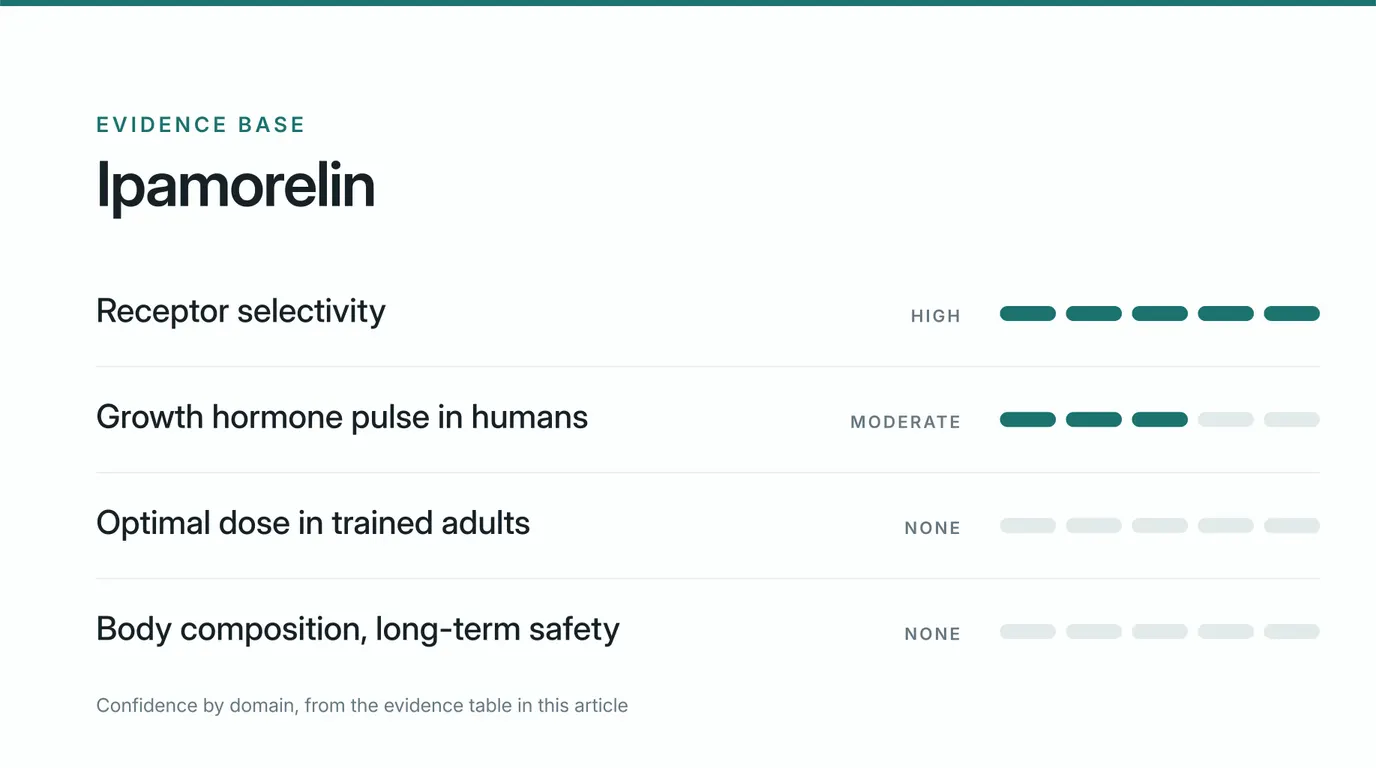
The short version
- Ipamorelin stimulates growth hormone release through the ghrelin receptor, GHS-R1a, not the GHRH receptor that Tesamorelin and CJC-1295 use.
- The protocols circulating online are convention, not clinical findings. No dose-ranging trial has ever been run in healthy trained adults.
- Novo Nordisk discontinued development in 2007 after a Phase 2 trial in postoperative ileus failed to meet its endpoint.
- It holds no marketing authorisation from the MHRA, FDA or EMA for any indication, anywhere.
Evidence: Preclinical, development discontinued. The receptor pharmacology is well characterised. Human development was abandoned before any dose-ranging programme in the population now using it.
What Is Ipamorelin?
Ipamorelin is a synthetic peptide belonging to a group of compounds known as growth hormone secretagogues.
Rather than supplying growth hormone directly, Ipamorelin works by encouraging the pituitary gland to release more of the body's own growth hormone.
It does this primarily by interacting with the growth hormone secretagogue receptor, also known as GHS-R1a. This is the same receptor involved in the activity of ghrelin, a hormone involved in appetite regulation and growth hormone signalling.
That mechanism is what makes Ipamorelin different from compounds such as CJC-1295, which acts through the growth hormone-releasing hormone pathway. We set the two receptor pathways side by side in Ipamorelin, Tesamorelin and CJC-1295.
Both can influence growth hormone release, but they do so through different signalling systems.
Ipamorelin has attracted attention because of its relatively selective effect on growth hormone compared with some of the earlier growth hormone-releasing peptides.
But understanding the mechanism is only the first part of understanding Ipamorelin. The next question is how much is actually used.
Ipamorelin Dosage: How Much Should You Take?
Search for Ipamorelin and you'll quickly find dosing charts everywhere.
100 mcg. 200 mcg. 300 mcg. Once per day. Twice per day. Before bed. In the morning. Eight-week cycles. Twelve-week cycles.
The problem is that these numbers can look much more established than they actually are.
There is no universally accepted clinical dosing protocol for healthy adults using Ipamorelin for muscle growth, fat loss, recovery or longevity.
Instead, the figures commonly found online are largely based on accumulated protocols and practical use rather than a definitive dose-ranging programme establishing the optimal dose for these goals.
That doesn't mean the numbers are meaningless.
It means they need to be labelled correctly.
The commonly discussed range is approximately 100–300 micrograms (mcg) per day, although higher amounts also appear in some protocols.
Commonly Discussed Ipamorelin Doses
Lower protocol: 100–150 mcg once daily
Moderate protocol: 200–300 mcg per day
Split protocol: 100–150 mcg twice daily
Higher protocol: up to approximately 400 mcg per day, divided between administrations
These figures should be considered commonly discussed protocols rather than approved medical dosing instructions.
More is also not automatically better.
Ipamorelin works by stimulating an existing physiological pathway, and increasing the amount does not necessarily produce a proportional increase in useful outcomes.
Once-Daily vs Twice-Daily Ipamorelin
There are two main approaches you'll see repeatedly.
The first is taking the entire daily amount once per day.
The second is dividing the total amount between two administrations.
A commonly discussed split schedule would be:
100–150 mcg in the morning
and
100–150 mcg before bed
The logic behind splitting the dose is straightforward. Instead of providing one opportunity for growth hormone stimulation, the protocol attempts to create two separate stimulation windows.
This is particularly common among people using Ipamorelin as part of a broader recovery or performance protocol.
However, there is not enough human evidence to say that twice-daily administration produces superior long-term muscle growth, fat loss or recovery compared with once-daily use.
The distinction is therefore between a commonly used protocol and a clinically proven optimal protocol.
They are not the same thing.
When Is the Best Time to Take Ipamorelin?
Timing is another area where online Ipamorelin advice becomes very specific.
The most commonly discussed administration windows are morning, around training and before bed.
Morning
Morning administration is often used as part of a split-dose protocol.
The attraction is mainly practical: one administration earlier in the day followed by another later allows the total daily amount to be divided.
Some protocols also recommend taking Ipamorelin away from food, particularly when using a morning administration.
Around Training
Ipamorelin is sometimes incorporated into pre- or post-workout protocols.
The reasoning comes from the relationship between exercise, growth hormone and recovery.
However, there is limited evidence demonstrating that taking Ipamorelin at a precise point around a workout creates a meaningful additional muscle-building effect.
The timing therefore shouldn't be treated as a magic window.
Before Bed
Bedtime is arguably the most popular timing recommendation.
There is a simple reason for this.
Natural growth hormone secretion is closely linked with sleep, with substantial pulses occurring during deeper stages of sleep.
This has led many Ipamorelin protocols to place the administration shortly before going to bed.
That doesn't mean bedtime is the only effective time to use Ipamorelin.
It means the timing fits logically with the body's natural GH rhythm.
Ipamorelin and Fasting
You'll often see Ipamorelin recommended while fasted or away from meals.
The reasoning is based on the relationship between nutrients, insulin and growth hormone secretion.
Some protocols therefore place administration in the morning before eating or at night several hours after the final meal.
There is no universally established fasting window that has been proven to be necessary for Ipamorelin.
The important point is not to confuse a protocol preference with a proven requirement.
Ipamorelin Dosage for Men
A commonly discussed range for men is:
200–300 mcg per day
This is often divided between morning and evening administrations.
However, there is no strong evidence establishing a specific "male dose" that is automatically optimal.
Individual response can vary according to factors such as age, body composition, baseline hormone levels, sleep and overall health.
The idea that men and women require completely separate dosing systems is therefore not supported by a robust dose-response evidence base.
Ipamorelin Dosage for Women
Protocols aimed at women commonly use lower amounts, often around:
100–200 mcg per day
usually administered once daily.
Again, these numbers should be understood as commonly reported protocols rather than clinically validated female-specific dosing.
There is insufficient evidence to claim that a particular microgram amount is universally optimal for women.
How Long Should You Take Ipamorelin?
Cycle length is another area where online recommendations tend to sound more definitive than the evidence allows.
You'll commonly see:
- 8-week protocols
- 12-week protocols
- 12–16-week protocols
- Longer-term use under medical supervision
The repeated appearance of these timeframes doesn't mean that researchers established one of them as the ideal cycle.
A twelve-week protocol appearing on dozens of websites is still a protocol convention unless controlled research demonstrates that twelve weeks provides the best balance of benefit and risk.
Long-term safety in healthy adults using Ipamorelin for physique enhancement or performance has not been established.
When Will You Notice Results?
This is where you should be particularly careful with online claims.
Many peptide guides provide a week-by-week roadmap:
Weeks 1–4: improved sleep and recovery.
Weeks 4–8: improved body composition.
Weeks 8–12: muscle growth and tissue repair.
The problem is that there isn't strong clinical evidence supporting such a predictable timeline.
Ipamorelin can stimulate growth hormone release relatively quickly after administration. That is very different from proving that a person will gain muscle or lose body fat after a particular number of weeks.
Results, if they occur, will depend on much more than the peptide itself.
Training, calorie intake, protein consumption, sleep, age, genetics and baseline hormone levels all matter.
Ipamorelin for Muscle Growth
Growth hormone plays an important role in tissue growth, metabolism and recovery, which explains why Ipamorelin is popular within bodybuilding and performance circles.
But stimulating growth hormone release does not automatically mean substantial muscle hypertrophy.
This distinction is often lost in peptide marketing.
Ipamorelin may influence the GH/IGF-1 pathway, but the evidence demonstrating significant increases in muscle mass in healthy adults using Ipamorelin is limited.
If the goal is building muscle, the fundamentals remain considerably better established: progressive resistance training, sufficient protein, adequate calories and consistent sleep.
Ipamorelin for Fat Loss
Growth hormone is involved in fat metabolism, which has created considerable interest in GH secretagogues as potential body-composition tools.
Ipamorelin is therefore frequently included in fat-loss protocols.
But it should not be viewed as a replacement for a calorie deficit.
Increasing growth hormone does not guarantee meaningful fat loss, and there is limited controlled human evidence demonstrating that Ipamorelin produces substantial reductions in body fat in healthy adults.
The mechanism is interesting.
The outcome evidence is much thinner.
Ipamorelin for Recovery
Recovery is one of the most common reasons people become interested in Ipamorelin.
Growth hormone and the IGF-1 pathway are involved in processes associated with tissue growth and repair.
This provides a biological rationale for investigating growth hormone secretagogues in recovery-focused protocols.
It does not, however, establish Ipamorelin as a proven treatment for a particular injury.
That distinction matters, especially when peptides are being marketed as if they can reliably repair tendons, joints or other damaged tissue.
Ipamorelin and Sleep
Sleep and growth hormone are closely connected.
A substantial proportion of daily growth hormone secretion occurs during deeper stages of sleep.
Because Ipamorelin can stimulate GH release, sleep is one of the areas where it is frequently discussed.
Some users report changes in sleep quality, but individual responses vary considerably.
There is also an important difference between increasing GH secretion and proving that Ipamorelin is an effective treatment for insomnia or another sleep disorder.
Those are separate claims.
Ipamorelin + CJC-1295
Ipamorelin and CJC-1295 are one of the most common combinations discussed in peptide protocols.
The reason comes down to their mechanisms.
Ipamorelin acts primarily through the growth hormone secretagogue receptor.
CJC-1295 is a growth hormone-releasing hormone analogue that acts through the GHRH pathway.
Because the two compounds influence growth hormone secretion through different signalling routes, combining them has a logical pharmacological basis.
A commonly discussed combination is:
Ipamorelin: 100–200 mcg
CJC-1295: 100–200 mcg
administered once or twice daily depending on the protocol.
However, the existence of a plausible mechanism does not establish that a particular combination or dose is optimal for healthy adults.
Stacking also makes it harder to identify which compound is responsible for a benefit or adverse effect.
Ipamorelin + BPC-157 or TB-500
Ipamorelin is also frequently included in broader peptide stacks alongside compounds such as BPC-157 or TB-500. Both have a far thinner human evidence base than their popularity suggests.
The theory is to target different aspects of recovery.
Ipamorelin is intended to influence the growth hormone pathway, while BPC-157 and TB-500 are commonly discussed in relation to tissue recovery.
The problem is that evidence for these combinations in humans is limited.
Combining several experimental compounds does not automatically make a protocol more effective.
It increases the number of variables involved, which can make both benefits and adverse effects more difficult to evaluate.
Ipamorelin Side Effects
Ipamorelin is often described as a relatively selective growth hormone secretagogue.
Selective does not mean risk-free.
Potentially reported effects include:
- Headaches
- Flushing
- Water retention
- Increased appetite
- Injection-site irritation
- Tingling or numbness
- Joint tightness
- Fatigue
- Effects associated with increased GH/IGF-1 activity
The likelihood of experiencing these effects can vary between individuals.
Higher exposure and combining multiple compounds that influence the GH/IGF-1 axis may also increase the potential for unwanted effects.
Does Ipamorelin Increase Hunger?
It can.
This is biologically plausible because Ipamorelin acts at the growth hormone secretagogue receptor, which is closely associated with ghrelin signalling.
Ghrelin is one of the body's major appetite-regulating hormones.
For someone trying to maintain a calorie deficit, an increase in appetite can therefore be particularly relevant.
The effect isn't necessarily evidence that something has gone wrong.
It can be consistent with the underlying pharmacology.
Ipamorelin and Water Retention
Changes in fluid balance can occur when growth hormone activity increases.
Some users therefore report mild water retention while using growth hormone secretagogues.
This may appear as:
- Temporary increases in scale weight
- A fuller or puffier appearance
- Tightness in the hands
- Joint discomfort
Significant or persistent swelling should not simply be dismissed as a normal consequence of peptide use.
Is Ipamorelin Safe?
The most accurate answer is that the long-term safety profile of Ipamorelin in healthy adults has not been established to the same standard as an approved medicine.
Its pharmacological mechanism is relatively well understood.
That does not answer every question about prolonged use.
Areas where uncertainty remains include:
- Long-term GH and IGF-1 exposure
- Glucose regulation
- Insulin sensitivity
- Fluid retention
- Cardiovascular effects
- Chronic administration
- Interactions with other hormones or peptides
This is an important distinction.
A compound can have a well-understood mechanism without having a well-established long-term safety profile.
Ipamorelin vs HGH
Ipamorelin and HGH are not the same thing.
HGH: directly supplies recombinant human growth hormone.
Ipamorelin: stimulates the body to release its own growth hormone.
That means Ipamorelin is not simply a weaker version of HGH.
The two approaches produce different pharmacological effects and different patterns of hormone exposure.
HGH also has approved medical uses under specific clinical circumstances, whereas Ipamorelin does not have an equivalent general approval for bodybuilding, fat loss or performance enhancement.
Is Ipamorelin Legal?
The regulatory position surrounding Ipamorelin depends on the jurisdiction and how the product is supplied.
Ipamorelin is not an approved general-purpose medicine for bodybuilding, fat loss, recovery or anti-ageing.
Products sold online as "research use only" are generally marketed as laboratory materials rather than medicines approved for human administration.
Availability from a supplier should therefore not be confused with regulatory approval.
Ipamorelin and Drug Testing
Ipamorelin is prohibited under the World Anti-Doping Agency's prohibited-substance framework.
It falls within the category covering growth hormone secretagogues.
For athletes subject to anti-doping rules, this means Ipamorelin can present a doping risk both in and out of competition.
Anyone subject to testing should check the current applicable rules before using compounds that affect the growth hormone axis.
What About Long-Term Ipamorelin Use?
Long-term use is one of the biggest areas where online peptide discussions get ahead of the evidence.
You will find protocols recommending several months of continuous use, followed by breaks or repeated cycles throughout the year.
The existence of these protocols doesn't establish that continuous use is safe, necessary or optimal.
The longer a compound is used, the more important long-term safety data become.
For Ipamorelin, those data are limited in the healthy population using it for performance, body composition and recovery.
The Bottom Line
Ipamorelin is interesting because the underlying pharmacology is considerably more credible than some of the claims made around it.
It is a growth hormone secretagogue that can stimulate the body's own release of growth hormone, and its relative selectivity is one of the reasons it became so popular.
Where the evidence becomes much less certain is dosing and long-term outcomes.
You'll find protocols recommending 100 mcg, 200 mcg, 300 mcg or more.
You'll find once-daily and twice-daily schedules.
You'll find eight-week, twelve-week and sixteen-week cycles.
But repetition does not turn a protocol into clinical evidence.
The most useful way to interpret these numbers is therefore to separate commonly used protocols from established medical dosing.
Ipamorelin has a credible mechanism.
The evidence for long-term use in healthy adults seeking improved muscle growth, fat loss or recovery is considerably less developed.
That distinction is what gets lost in most online dosing guides.
Frequently Asked Questions
What is the most common Ipamorelin dose?
Common online protocols generally use around 100–300 mcg per day, either as a single administration or divided into two doses. These are commonly discussed protocols rather than universally established clinical doses.
Is 200 mcg of Ipamorelin a common dose?
Yes. 200 mcg appears frequently in online Ipamorelin protocols, either as a single daily administration or divided into smaller doses.
Is 300 mcg of Ipamorelin a high dose?
300 mcg falls within the range frequently discussed online, but there is no validated dose-response framework that allows a universal "high dose" threshold to be established for healthy adults.
Should Ipamorelin be taken once or twice daily?
Both approaches are commonly used. Once-daily administration is simpler, while split dosing is often used by people attempting to create multiple GH stimulation windows.
What is the best time to take Ipamorelin?
Bedtime is one of the most common administration times because natural growth hormone secretion is strongly associated with sleep. Morning and split-dose protocols are also commonly discussed.
Should Ipamorelin be taken fasted?
Many protocols recommend administration away from meals, but there is no universally established fasting period that has been proven necessary for Ipamorelin to work.
How long should an Ipamorelin cycle last?
Common online protocols range from approximately 8 to 16 weeks, although there is no universally established optimal cycle length for healthy adults.
Can Ipamorelin be combined with CJC-1295?
Yes, the two are commonly combined because they influence growth hormone secretion through different pathways. However, commonly used combination protocols should not be mistaken for clinically validated dosing regimens.
Does Ipamorelin help with fat loss?
Ipamorelin stimulates growth hormone release, and growth hormone is involved in fat metabolism. However, evidence that Ipamorelin itself produces substantial fat loss in healthy adults remains limited.
Does Ipamorelin increase appetite?
It can. Because Ipamorelin interacts with the growth hormone secretagogue receptor associated with ghrelin signalling, increased appetite is biologically plausible.
Does Ipamorelin build muscle?
Ipamorelin can stimulate growth hormone release, but there is limited controlled evidence demonstrating substantial muscle growth in healthy adults. Training, nutrition and recovery remain the primary drivers of muscle hypertrophy.
Is Ipamorelin approved for human use?
Ipamorelin does not have general regulatory approval as a medicine for bodybuilding, fat loss, recovery or anti-ageing.
Is Ipamorelin prohibited in sport?
Yes. Ipamorelin falls under the prohibited growth hormone secretagogue category in WADA's anti-doping framework and is prohibited at all times for athletes subject to those rules.