Tesamorelin: What the Approval Actually Covers
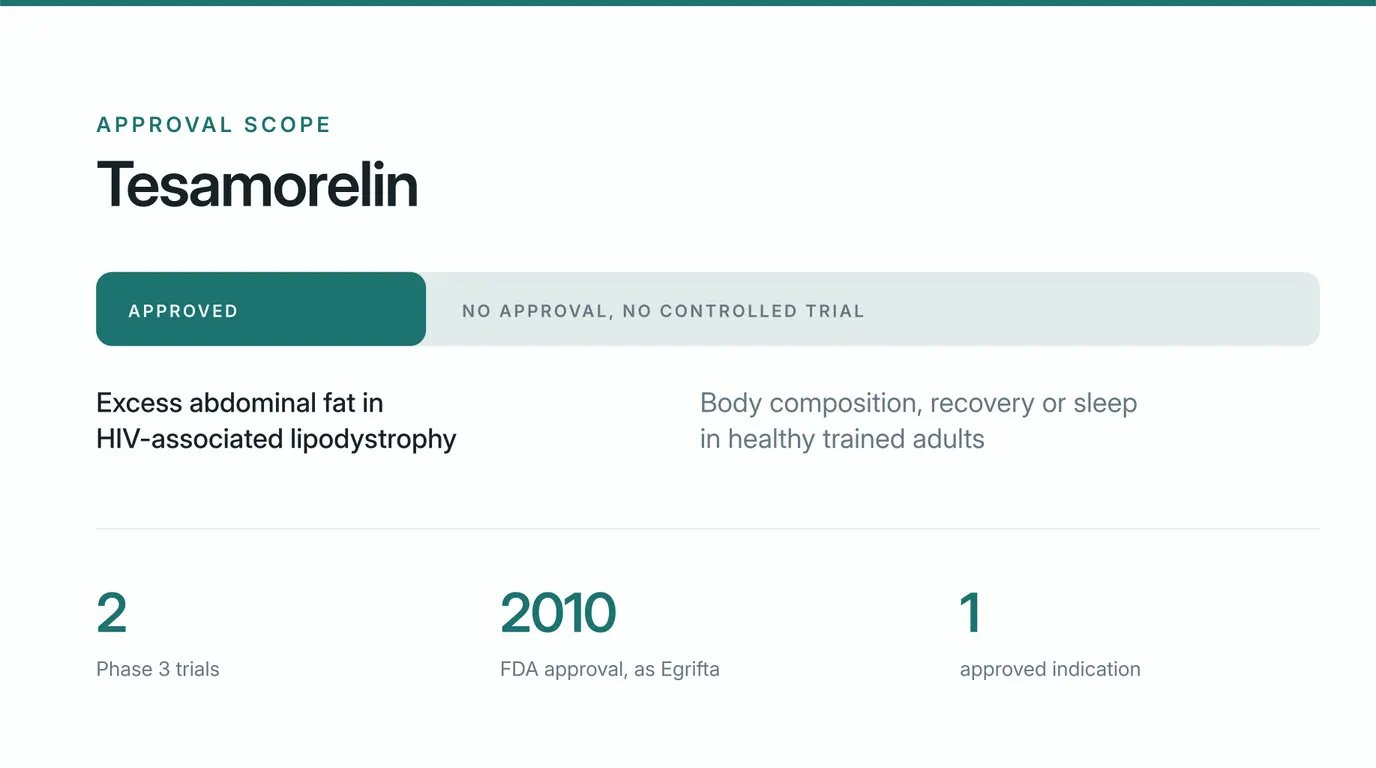
Tesamorelin is one of the few peptides in this space with a genuine regulatory approval behind it. The approval is for a population most people reading about it do not belong to.
The short version
- Tesamorelin is approved, which almost nothing else in this category is, but only for excess abdominal fat in people with HIV-associated lipodystrophy.
- The trials measured visceral fat, not muscle. There is no controlled evidence that it builds lean mass in healthy trained adults.
- The effect reverses when you stop, and glucose tolerance moves in the wrong direction while you are on it.
Evidence: Approved, narrow indication. Large placebo-controlled trials exist and the compound is approved, but only for HIV-associated lipodystrophy. No approval or controlled trial supports use for body composition in healthy adults.
Tesamorelin sits in an odd position. Almost every compound covered on this site is preclinical, unapproved, or both. Tesamorelin is neither. It went through two large placebo-controlled Phase 3 trials, it was approved by the FDA in 2010 under the name Egrifta, and it has been prescribed clinically for over a decade.
That makes it the strongest evidence base of anything in the peptide conversation. It also makes the gap between the evidence and the marketing easier to see, because for once there is a real file to compare the claims against.
What the molecule is
Tesamorelin is a synthetic analogue of growth hormone releasing hormone. The natural hormone is a 44 amino acid peptide made in the hypothalamus that travels to the pituitary and triggers growth hormone release. Its problem, as a drug, is that it is destroyed within minutes by the enzyme DPP-4.
Tesamorelin is that same sequence with a modification at one end that blocks the enzyme. The result survives long enough to be injected once a day and still reach the pituitary.
The distinction that matters is what it does not do. It is not growth hormone. It does not put growth hormone into your body. It asks the pituitary to release its own, which means output stays under the body's existing feedback control. Levels rise, then the loop pulls them back. That is a meaningfully different pharmacology from injecting growth hormone directly, and it is the main argument for this class of compound.
What the trials measured
Two 26-week placebo-controlled trials enrolled adults with HIV-associated lipodystrophy, a condition in which antiretroviral therapy drives fat into the abdominal cavity around the organs. That visceral fat is metabolically active and associated with cardiovascular risk, which is why it was worth treating.
The primary endpoint was visceral adipose tissue measured by CT scan. Tesamorelin at 2 mg daily produced reductions in the region of 15 to 18 percent against placebo, sustained across the treatment period. IGF-1 rose substantially, as the mechanism predicts. Later work in the same population also showed reductions in liver fat.
Read the endpoint carefully. The trials measured a specific fat compartment in a specific disease. They did not measure lean mass gain, strength, recovery or training adaptation, and they were not run in healthy people.
What happens when you stop
An extension phase answered a question most coverage skips. Participants who came off tesamorelin regained the visceral fat. The compound suppresses the compartment while it is being taken, and the suppression is not durable afterwards.
This is the same pattern seen with the GLP-1 agonists, and it points at the same underlying truth. A drug that reduces a load does not necessarily change the process generating the load. Stop the drug and the process resumes.
The glucose problem
Growth hormone opposes insulin. That is basic endocrinology, not a surprising finding, and it showed up in the trials as measurable worsening of glycaemic parameters in some participants.
The effect was modest and it was reversible, but it points in the opposite direction from the reason most people are interested in the compound. Someone using tesamorelin to reduce abdominal fat for metabolic reasons is accepting a drug that makes one metabolic marker worse in order to improve another. In the approved population, where visceral fat carries a specific cardiovascular risk, that trade was judged worthwhile. Outside it, nobody has run the study that would tell you.
Where the evidence stands
| Domain | Evidence | Confidence |
|---|---|---|
| Visceral fat reduction in HIV lipodystrophy | Two Phase 3 RCTs, approved indication | High |
| IGF-1 elevation | Consistent and dose-related | High |
| Liver fat reduction in the same population | Controlled data | Moderate to high |
| Effect reverses on discontinuation | Extension data | High |
| Glucose tolerance worsens modestly | Trial data | Moderate to high |
| Lean mass gain in healthy trained adults | No controlled trial | None |
| Recovery, sleep or joint benefit | No controlled trial | None |
| Long-term safety beyond trial duration | Not established | Low |
The pattern is worth sitting with. The rows with high confidence are all things the trials were designed to measure in the population they enrolled. The rows with no evidence are the ones the bodybuilding coverage leads on.
Where the dosing conventions come from
The 2 mg daily figure that circulates is not a bodybuilding protocol that someone worked out. It is the approved clinical dose, lifted from the trials and applied to a different population for a different purpose.
That does not make it wrong. It does make it an extrapolation rather than a tested regimen, and the cycling schedules that get attached to it, the eight to twelve week blocks and the post-cycle timings, have no trial behind them at all. They are convention.
How it compares within the class
Tesamorelin, ipamorelin and CJC-1295 get grouped together as growth hormone peptides, which obscures the thing that actually separates them. Tesamorelin and CJC-1295 act on the GHRH receptor. Ipamorelin acts on a different receptor entirely, the ghrelin receptor, and mimics a different signal.
More to the point here: only one of the three has ever completed Phase 3 and been approved. If evidence quality is what you care about, that is the whole comparison.
The legal position
Tesamorelin is approved, but the approval is for a named indication in a named population, supplied on prescription. Material sold as research grade sits in the separate channel covered in our peptide regulation piece: it is a laboratory reagent, not a medicine, and it is not approved for human use in any jurisdiction regardless of the fact that a prescription version of the same molecule exists.
The existence of an approved product does not transfer its approval to material bought through a different channel.
Editorial perspective
Tesamorelin deserves more respect than most of this category and less enthusiasm than it gets.
More respect, because the file is real. Two placebo-controlled Phase 3 trials and a regulatory approval put it in a different class from compounds resting on rodent studies and forum consensus. When it reduces visceral fat, that is a measured finding, not an inference.
Less enthusiasm, because everything interesting about it to a general audience sits outside what was studied. The trials enrolled people with a specific drug-induced pathology. Whether a healthy trained adult with ordinary abdominal fat responds the same way is not known, because the study has not been run. The IGF-1 rise is real and gets used as a proxy for muscle benefit, but a biomarker moving is not the same as an outcome improving, and the trials that measured body composition were not measuring the thing lifters care about.
The honest summary is that tesamorelin has strong evidence for one thing in one population, weak evidence by extrapolation for anything else, and a metabolic trade-off that gets left out of most of the coverage.
Frequently asked
Is tesamorelin approved? Yes, for reduction of excess abdominal fat in adults with HIV-associated lipodystrophy. Not for body composition, performance or recovery in healthy adults.
Does it build muscle? No controlled trial in healthy trained adults has tested this. IGF-1 rises, which is the mechanism people reason from, but reasoning from a biomarker is not the same as evidence of an outcome.
Is it safer than growth hormone? The mechanism is arguably more physiological, since output stays under pituitary feedback control rather than being supplied from outside. That is an argument about mechanism, not a demonstrated safety comparison, and no head-to-head trial exists.
Does the fat come back? In the extension data, yes. The reduction was not maintained after discontinuation.
What about the glucose effect? Modest worsening of glycaemic measures was seen in trials and is consistent with growth hormone's known action against insulin. It reversed on stopping.
References
- Falutz J, et al. Metabolic effects of a growth hormone-releasing factor in patients with HIV. N Engl J Med. 2007.
- Falutz J, et al. Effects of tesamorelin on visceral fat and health outcomes in HIV. J Acquir Immune Defic Syndr. 2010.
- Stanley TL, et al. Effects of tesamorelin on visceral adiposity and metabolic parameters. Clin Infect Dis. 2012.
- Stanley TL, et al. Effects of tesamorelin on hepatic fat in people with HIV and NAFLD. Lancet HIV. 2019.
- US FDA. Egrifta prescribing information.